
Arthur Conan Doyle and the Ghost Club
Witches and their magic are everywhere, especially now, at the spooky time of year, around Halloween, or to give it its old name, Samhain.
Sir Arthur Conan Doyle was the creator of the world’s most famous rationalist detective, Sherlock Holmes, yet he himself was a convinced believer in the existence of the supernatural. This paradox has always fascinated me.
Just as there were two sides to Conan Doyle – the man of science/medical man and the novelist – so there are two sides to me as a writer. As a professional historian, it’s my job is to try to establish the truth about the past and about past lives – as far as it can be done through the evidence of primary sources from the time. Put simply, as a historian it’s my responsibility not to make anything up, because if historians start lying to us about the past then as a society we really are lost. But I’m also a writer of creative fiction, who finds that aspect of my life both liberating and insightful. So long as I’m clear about the distinction between writing history and writing fiction, I’m fine with it. In fact, one form of writing and the insights that go with it, can actually benefit the other.
In Conan Doyle’s case, his fascination with the psychic realm led him to become a member of the mysterious Ghost Club. The club was founded at Trinity College, Cambridge in the 1860s, under the name the Everlasting Club. At different times, members included Charles Dickens; Algernon Blackwood – writer of many ghost stories; William Butler Yeats; Harry Price – the famous ghost hunter who investigated the apparent supernatural occurrences at Borley Rectory; the occult novelist, Dennis Wheatley; and the star of many films, Peter Cushing.
The Ghost Club carried out many investigations of the supernatural, but they also met regularly for social events where they often told ghost stories. At their monthly meetings, often in West End restaurants, they would take a roll-call of members, living and dead. Places would be left vacant for deceased club members. One of the things that intrigued me about the Ghost Club was that until the late 1930s, women were not admitted to membership. Sir William Crookes – renowned scientist and discover of thalium, as well as a Ghost Club member – stated that the club members should not discuss their activities in the presence of women, on the grounds, presumably that women were too emotional or ‘gossipy’. The club still meets and thrives, and still carries out ghostly investigations, though its character has changed very much since the early twentieth century.
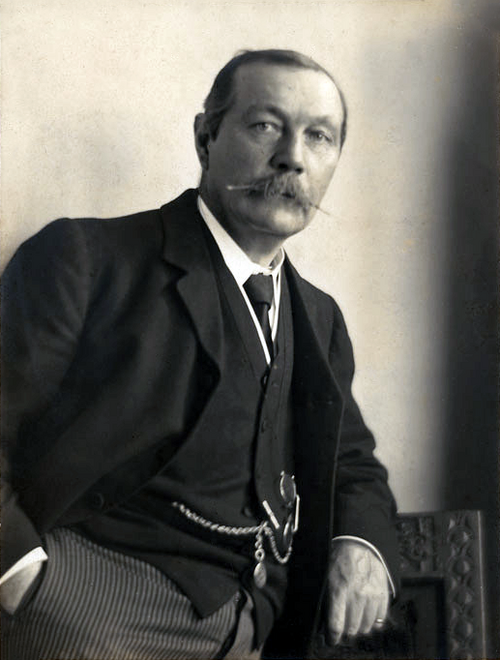
Photograph taken by Walter Benington, 1914.
I had already written one novel, Circle of Shadows, about a young woman in 1904 who becomes an occult detective, even though the world of Edwardian patriarchy is ranged against her. From there it was a short step to ask myself how my heroine would have responded to the comfortable assumption of the Edwardian Ghost Club that women had no place there. The consequence was my next novel, Domain of Darkness, when Arthur Conan Doyle gives my heroine her next case, when he asks her to do what Sherlock Holmes couldn’t – investigate a murderous supernatural curse on the Ghost Club.
Find out more about Domain of Darkness, Marisa’s novel inspired by Arthur Conan Doyle and the Ghost Club here.